Letter II · The discovery of form: the circle and the house
By Marcus Yabe ·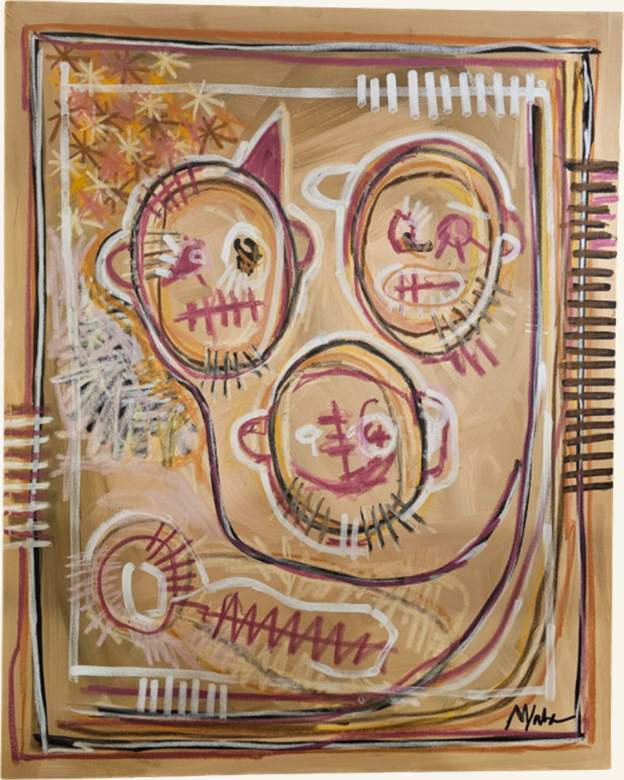
To whoever still keeps the family portrait on the shelf,
After the cry comes the question: where did it come from? I kept reducing the line until it became an accent, and from the accent was born the oldest form there is, the circle. The circle is womb, is eye, is round table, is bond. It is also the exact shape of someone who spins in place. It was with the circle that I came into the house.
This is the phase in which I painted families. Not the family in the picture frame, but the one I recognize seated at the table, carrying what went unsaid. In Holy Family, I painted the same mystery three times. First in vivid red, flesh and conflict, the bonds appearing more as tether than as shelter. Then in darkened tones, threads about to snap, love holding out among scars. Finally in green, an intimate jungle where bodies embrace to protect and, in the same gesture, to surveil. For me, the sacred was never calm. It is survival in its rawest state.
I did not worry about cleanliness. My commitment is to the narrative. I laid down layers and more layers with no intention of revealing everything, because every family has a basement. I left the chaotic energy down there, underground, holding up what appears on the surface the way an inheritance does.
Then the faces came to me. Seven Variations of the Same Silence are seven blue masks I painted in order to listen to what is not said: the same gesture trying to translate itself into seven silenced voices. And in the Familexas, I gathered the faces in threes, as family, as trinity, as old photograph. The stitched mouths say more than any scream. Under an August sky sprinkled with extinguished stars, they have been waiting too long. In warm clay, they emerge like fossils of a memory that withstood the dust. Among stars and whispers, they breathe together without speaking, because sometimes all that remains of a family is its gravity.
I also painted bodies that surrender. Two Bodies Lying between the Forest, the Sky and the River do not flee: they rest. I did not want to separate them from the landscape; I wanted to return them to it. It is the only place in this phase where love rests without fear.
I learned, in this phase, that belonging and imprisoning use the same verb. That the house that shelters us is the same one that silences us. And that nothing that is buried is dead: there is life in the bones, there are stories in the clay, there are eyes that still look at us from down there.
Marcus Yabe, Phase II, 2020 to 2024